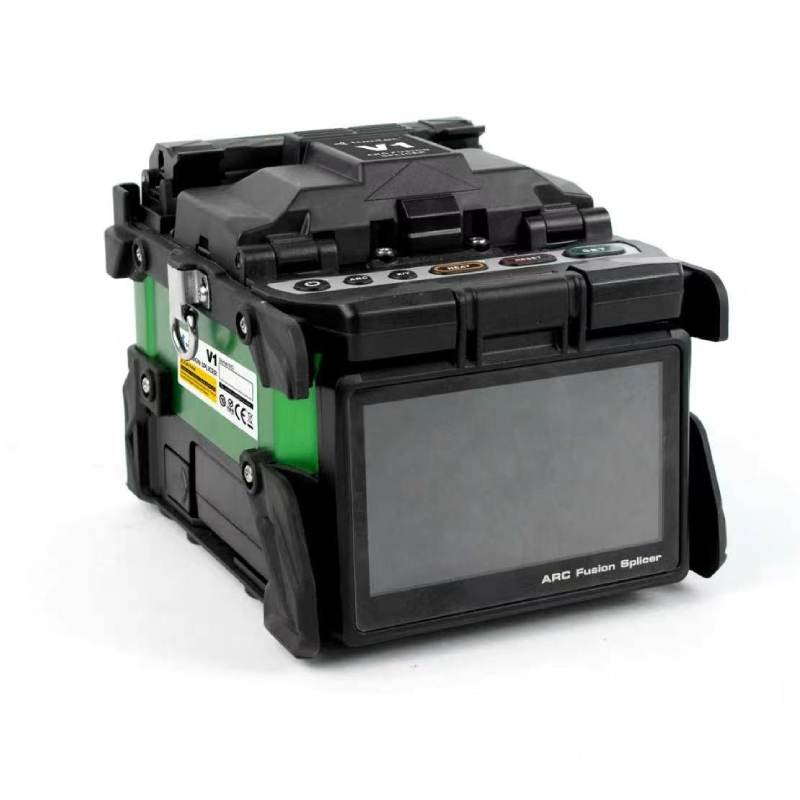
Trunk-line splicing is production work. A crew closing joints along a backbone route repeats the same cycle all day — strip, clean, cleave, splice, protect — and the machine in the middle of that cycle sets both the pace of the work and the loss figures the finished route will be accepted on. The K-V1 is our core-alignment fusion splicer built for exactly that work: a 6–10 second splice, typical single-mode loss of 0.02 dB, an arc that calibrates itself as conditions change, and a battery that runs past 250 splice-and-heat cycles on one charge.
Core Alignment, Because a Trunk Route Is Accepted on Loss
The K-V1 aligns on the fiber core itself, imaging the fibers with dual cameras and bringing the cores together before the arc fires. That is what holds the loss down joint after joint: typical splice loss is 0.02 dB on single-mode fiber, 0.01 dB on multimode, 0.04 dB on DS and NZDS, and 0.02 dB on bend-insensitive fiber, with return loss of 60 dB or better. The machine handles SM, MM, DS, NZDS and BI fiber, fiber diameters of 0.25–0.3 mm including indoor cable, coating diameters of 0.125–1 mm, and cleave lengths of 5–16 mm — the full run of what a trunk crew meets between the exchange and the last closure. Every joint gets a splice loss estimate on screen, so a bad joint is re-done on the pole, not discovered at acceptance testing.
A 6–10 Second Splice, a 15–30 Second Heat
Cycle time is crew time. The K-V1 completes a splice in 6–10 seconds, and its heater — with multiple heating modes for different sleeves and cables — finishes a typical cycle in 15–30 seconds on 20–60 mm splice protection sleeves. While one joint is shrinking, the next fiber is being prepared; the machine is rarely the bottleneck on a well-run route.
An Arc That Calibrates Itself
Arc conditions do not stay put outdoors. Air pressure and temperature shift between a valley floor in the morning and a ridge at noon, and a fixed discharge quietly drifts away from its best setting. The K-V1 calibrates its arc automatically against air pressure and temperature, so splice quality holds across the working range — altitudes from 0 to 5,000 m and temperatures from −10 °C to +50 °C — without the operator stopping to run manual calibration routines.
250+ Cycles per Charge, 5,000 Arcs per Set of Electrodes
The 5200 mAh lithium battery delivers more than 250 typical splice-and-heating cycles per charge — a full day of trunk work without looking for a generator or a vehicle socket. The electrodes are rated for 5,000 discharges, so the wear part that decides arc quality is a planned spare, not a surprise. And because routes are documented, the K-V1 stores the 10,000 latest splice records and 10,000 splice images on board, ready to pull over its Mini USB 2.0 interface.
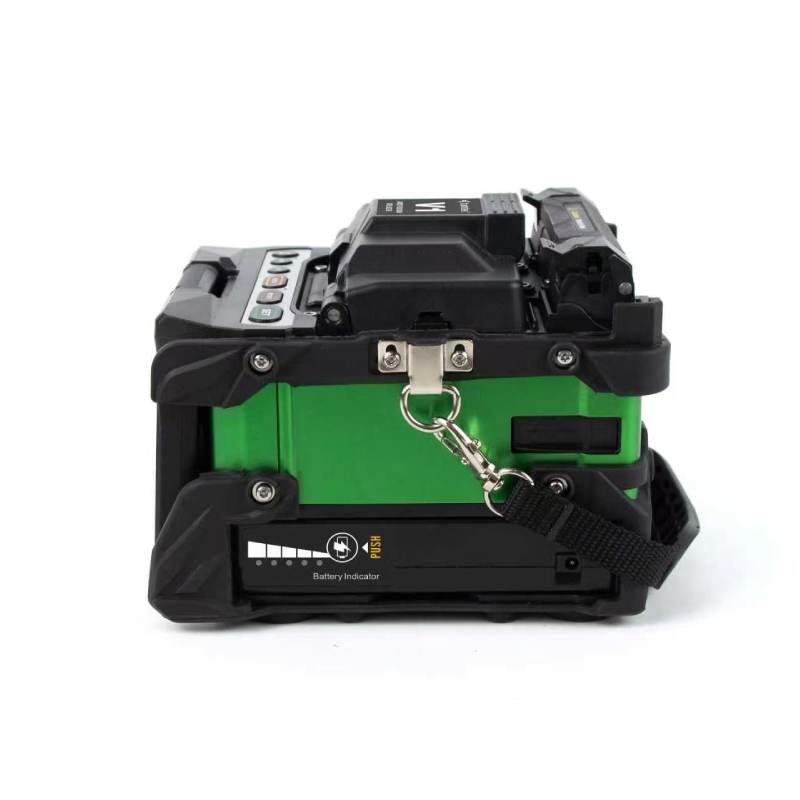
Two Cameras, One 4.3-Inch Touchscreen
The dual cameras view the fiber from two directions at 90°, with X, Y and X-Y views at up to 380× magnification on a 4.3-inch 480×272 color touchscreen — the operator sees the cores, the cleave faces and the finished joint, not a guess. The machine works by buttons as well as touch, which matters with gloves on. Two high-power white LEDs light the splice chamber, and the keypad is blue-backlit for night work inside a closure or a cabinet.
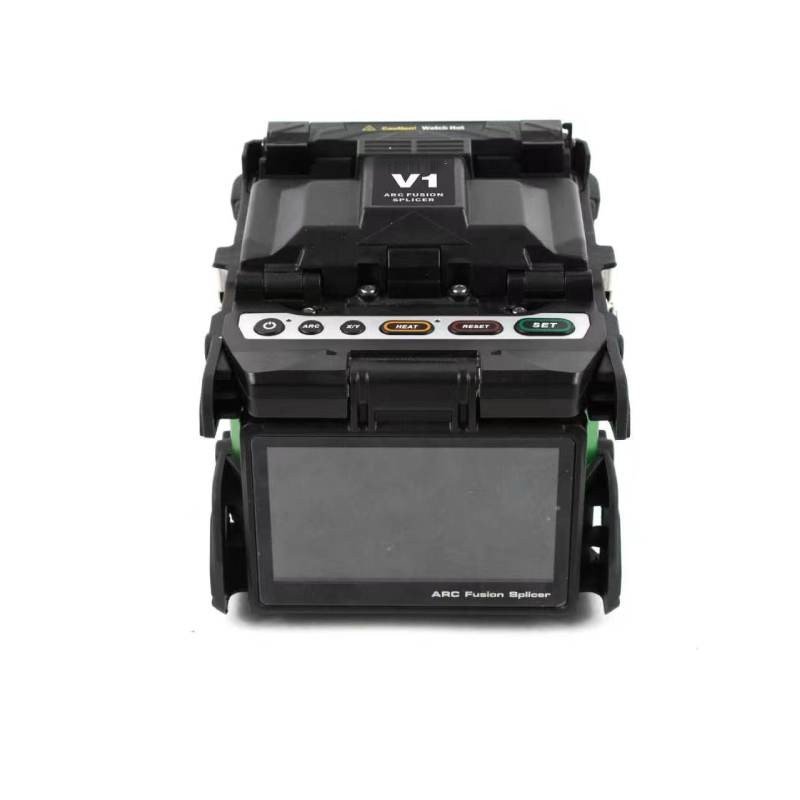
Modes for Every Fiber on the Route
The K-V1 ships with 41 preset splice modes and room to store up to 100, so the standard fibers on a network each get their own proven program and the crew selects rather than experiments. A built-in tension test pulls each joint at 1.96–2.25 N — proof the splice is mechanically sound before the sleeve goes on and the tray is closed.
Compact Enough for the Pole, Built for the Route
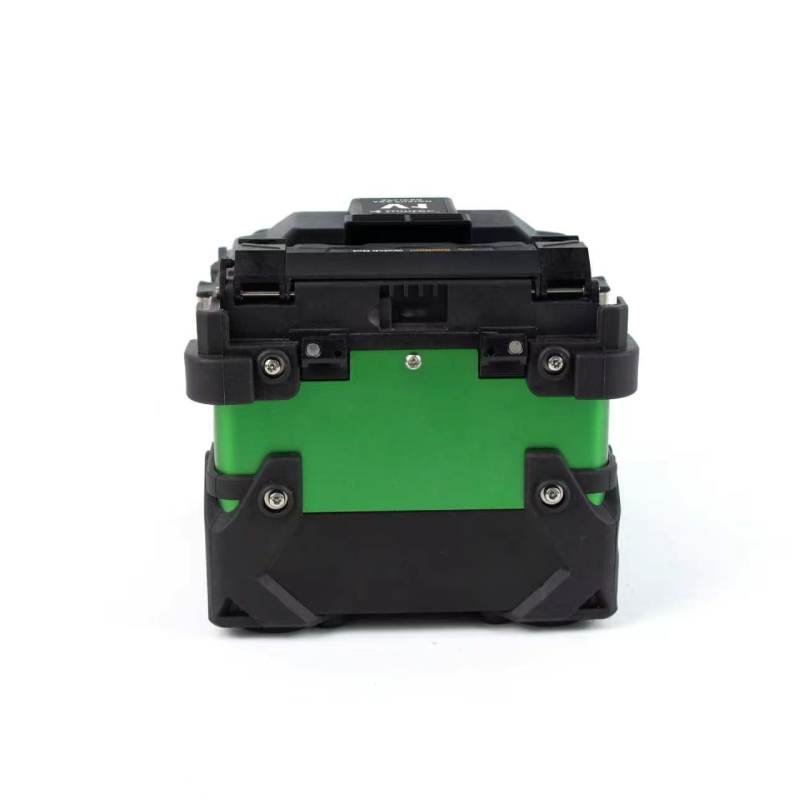
At 140 × 165 × 126.5 mm including its rubber bumpers, and 1.36 kg for the main unit, the K-V1 goes up a pole or into a crowded splice van without a second thought. It works in 0–95% relative humidity and wind up to 15 m/s — the conditions trunk work actually happens in. Electrodes and the other splicer wear parts are standard lines we stock alongside the machine, covered in our guide to fusion splicer spare parts.
Specifications
| Model | K-V1 Fusion Splicer |
|---|---|
| Alignment | Core alignment |
| Application | Trunk line projects |
| Fiber types | SM / MM / DS / NZDS / BI |
| Typical splice loss | SM 0.02 dB · MM 0.01 dB · DS 0.04 dB · NZDS 0.04 dB · BI 0.02 dB |
| Return loss | ≥ 60 dB |
| Splice time | 6–10 s |
| Heating | Multiple heating modes; typical 15–30 s; sleeves 20–60 mm |
| Display | 4.3-inch 480×272 color LCD touchscreen; dual cameras; X / Y / X-Y views up to 380× |
| Splice modes | 41 preset; up to 100 storable |
| Storage | 10,000 splice records; 10,000 splice images |
| Battery | 5200 mAh lithium; > 250 splice + heating cycles per charge |
| Electrode life | 5,000 discharges |
| Dimensions | 140 × 165 × 126.5 mm (with rubber bumpers) |
| Weight | 1.36 kg (main unit, with rubber bumpers) |
| Operating conditions | Altitude 0–5,000 m; −10 °C to +50 °C; 0–95% humidity; max. wind 15 m/s |
| Interface | Mini USB 2.0 |
The K-V1 is in our splicing line now, alongside the SD-6A and SD-9 — full details and the datasheet are on the K-V1 product page. To order, tell us the quantity you need via the quote form below, on WhatsApp +86 150 6823 2998, or at silvia@licoom.com. EXW factory pricing on request.