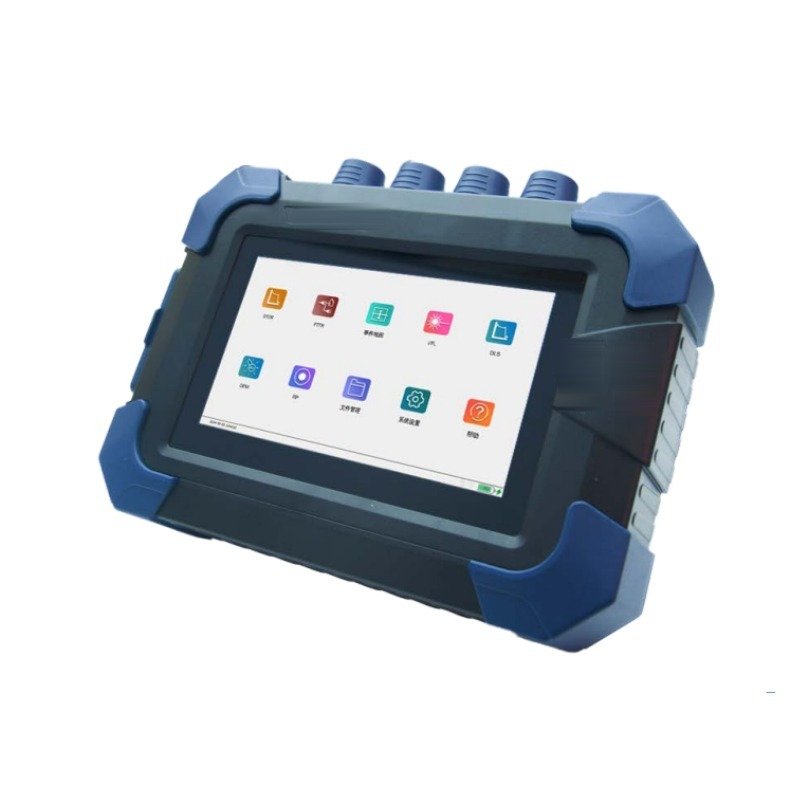
A PON that is already carrying subscribers is the hardest network to test. Taking it down for a measurement is not an option, and a conventional OTDR wavelength fights the live traffic. The K-800PON is our PON OTDR built for exactly that job: it tests at 1625 nm while the network stays in service, with 44 dB of dynamic range — enough to measure a complete PON through a 1×128 splitter — and a one-button Smart Link map that shows the whole link at a glance.
1625 nm: Test the Live Network Without Dropping a Subscriber
The K-800PON measures at 1625 nm, a wavelength that sits outside the traffic the network carries, so a test runs on a live PON without interrupting any user. That changes how acceptance and fault-finding work on a working network: a crew can verify a feeder, a splitter leg or a drop while subscribers stay online, instead of scheduling a maintenance window and hoping the fault is still there when the window opens. The same instrument also measures at 1310 and 1550 nm, so a dark fiber or a new build is tested with the same box.
44 dB of Dynamic Range, Through a 1×128 Splitter
Dynamic range is what decides whether an OTDR can see the far end of a PON at all. The K-800PON reaches 44 dB at 1625 nm, and 34 dB at 1310 nm and 32 dB at 1550 nm, measured at maximum pulse width with 3 minutes of averaging. In practice that means a full PON measured end to end through a 1×128 splitter — the whole split, not just the feeder. The measurement range runs from 0.3 to 200 km, with a loss threshold of 0.05 dB, loss resolution of 0.001 dB and sampling resolution from 0.125 to 8 m. Event dead zone is 0.8 m at 1625 nm (1.2 m at 1310/1550 nm) and attenuation dead zone 3.5 m (6 m at 1310/1550 nm), so closely spaced events — a connector followed by a splitter port, for example — still show as separate events instead of one blur.
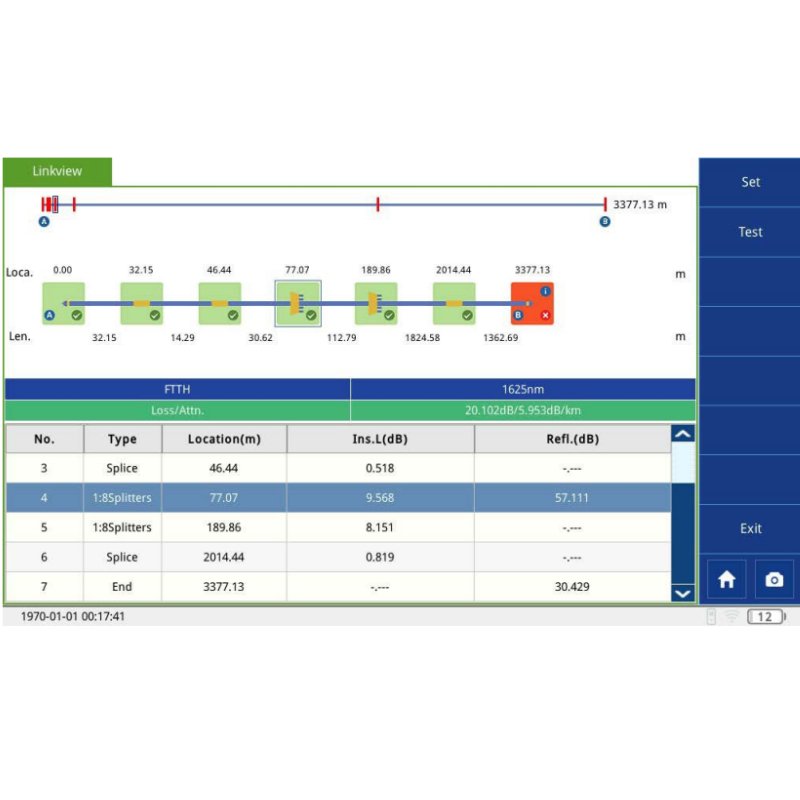
Smart Link: One Button, the Whole Link as a Map
An OTDR trace is only useful if the person holding the instrument can read it. Smart Link removes the setup: one button, no manual settings, and the link comes back as a graphic event map instead of a raw trace to interpret. In FTTx mode the map identifies the splitter port count and the split point, so a crew sees where the feeder ends, where the split happens and where each leg runs — a picture a supervisor can read as easily as the technician who took the measurement. Results refresh in typically 1 second, and more than 10,000 traces store on an SD card of 8 GB or larger, so a day of acceptance testing stays on the instrument until it is pulled off for the job file.
A Power Meter and a Light Source in the Same Box
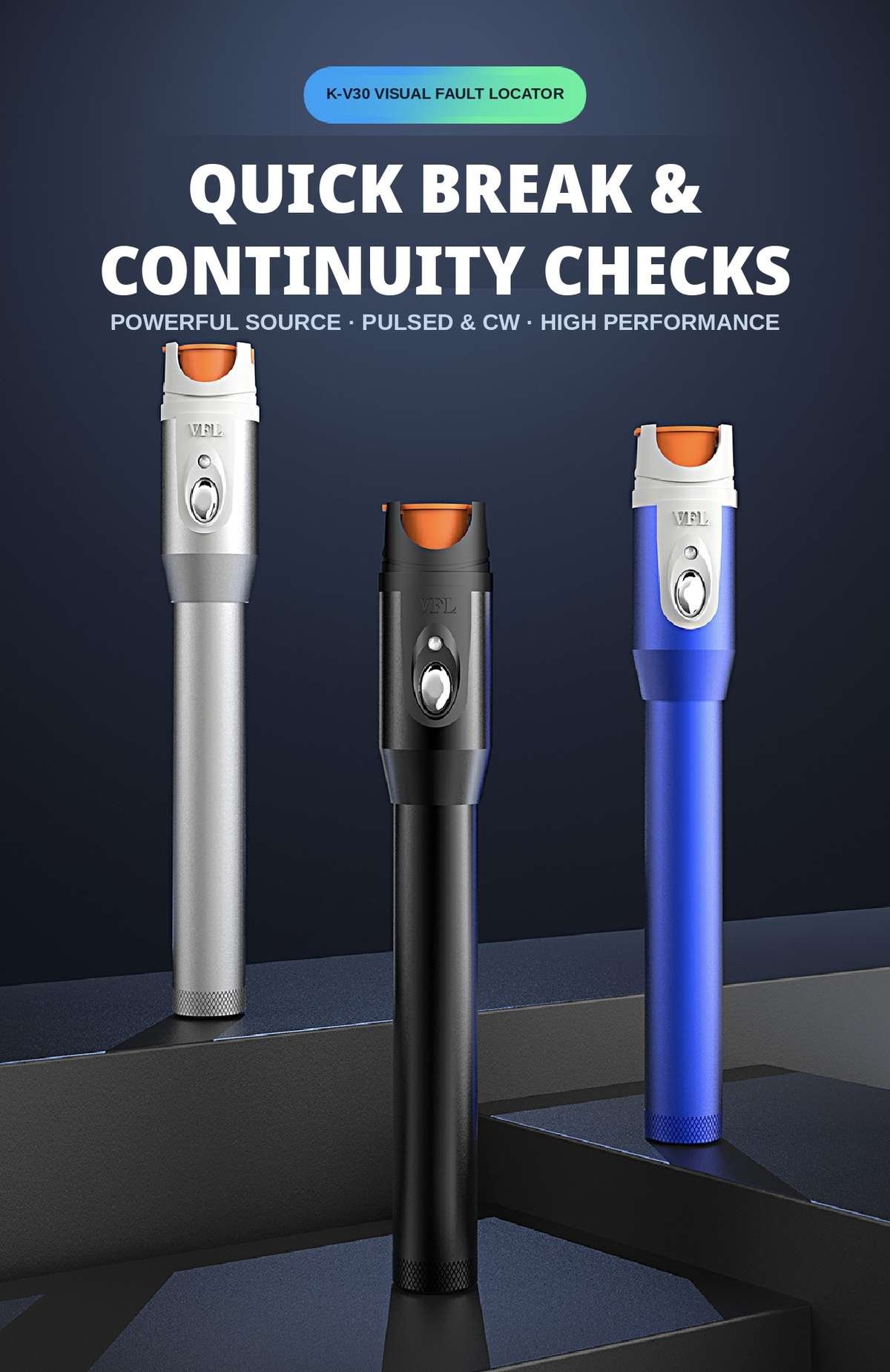
The K-800PON carries the two tools a PON crew reaches for most after the OTDR itself. The built-in power meter is calibrated at 1310 and 1550 nm, with a range of −40 to 0 dBm and accuracy of ±0.02 dBm, for single-mode live fault troubleshooting on the same visit. The built-in light source works at 1310 and 1550 nm with CW, 270 Hz, 1 kHz and 2 kHz modulation. A 650 nm visual fault locator reaches up to 3 km for the short, visible faults — a bad connector, a tight bend at a closure — that an OTDR trace alone does not pin down. An optional fiber end-face inspection probe magnifies 400× with 0.5 µm resolution, so a dirty connector is caught before it becomes a loss figure on the report.
Built for a Day on the Route
Field instruments earn their keep by lasting the working day. The lithium battery runs for 8 hours or more of continuous work, and the instrument works from −10 °C to +50 °C in up to 95% relative humidity (non-condensing) — the conditions a PON crew actually works in. At 263 × 75 × 203 mm and 1.784 kg it is a one-hand carry between the van and the cabinet, and it stores from −40 °C to +70 °C between jobs. Distance accuracy is ±(0.75 m + 2.5×10⁻⁵ × distance + sampling interval), with linearity of ±0.05 dB/dB, so the numbers on the report hold up when a second crew re-measures the same link.
Specifications
| Model | K-800PON PON OTDR |
|---|---|
| Application | PON / FTTx comprehensive testing |
| Test wavelengths | 1310 / 1550 nm; 1625 nm (±20 nm) |
| Dynamic range | 1310 / 1550 nm: 34 / 32 dB; 1625 nm: 44 dB (maximum pulse width, 3 min averaging) |
| Event dead zone | 1310 / 1550 nm: 1.2 m; 1625 nm: 0.8 m |
| Attenuation dead zone | 1310 / 1550 nm: 6 m; 1625 nm: 3.5 m |
| Linearity | ±0.05 dB/dB |
| Loss threshold | 0.05 dB |
| Loss resolution | 0.001 dB |
| Sampling resolution | 0.125–8 m |
| Distance accuracy | ±(0.75 m + 2.5×10⁻⁵ × distance + sampling interval) |
| Measurement range | 0.3–200 km |
| Real-time refresh | Typically 1 s |
| Data storage | SD card (8 GB or larger), over 10,000 traces |
| Light source | 1310 / 1550 nm (±20 nm), CW / 270 Hz / 1 kHz / 2 kHz modulation |
| Power meter | Calibrated 1310 / 1550 nm, range −40 to 0 dBm, accuracy ±0.02 dBm |
| Visual fault locator | 650 nm, up to 3 km |
| End-face inspection (optional probe) | 400× magnification, 0.5 µm resolution, 0.3 × 0.28 mm view area, PAL / NTSC output, USB signal input |
| Display | Color touchscreen |
| Dimensions | 263 × 75 × 203 mm (H × W × D) |
| Weight | 1.784 kg |
| Operating temperature | −10 °C to +50 °C |
| Storage temperature | −40 °C to +70 °C |
| Relative humidity | 0%–95% (non-condensing) |
| Battery | Lithium, 8 hours or more continuous operation |
The K-800PON is in our testing line now, at the head of the range — full details and the datasheet are on the K-800PON product page. For a closer look at how to read an OTDR trace, see our guide to OTDR basics: reading a trace in 5 steps. To order, tell us the quantity you need via the quote form below, on WhatsApp +86 150 6823 2998, or at silvia@licoom.com. EXW factory pricing on request.