
How Long Does a Fiber Cleaver Blade Last?
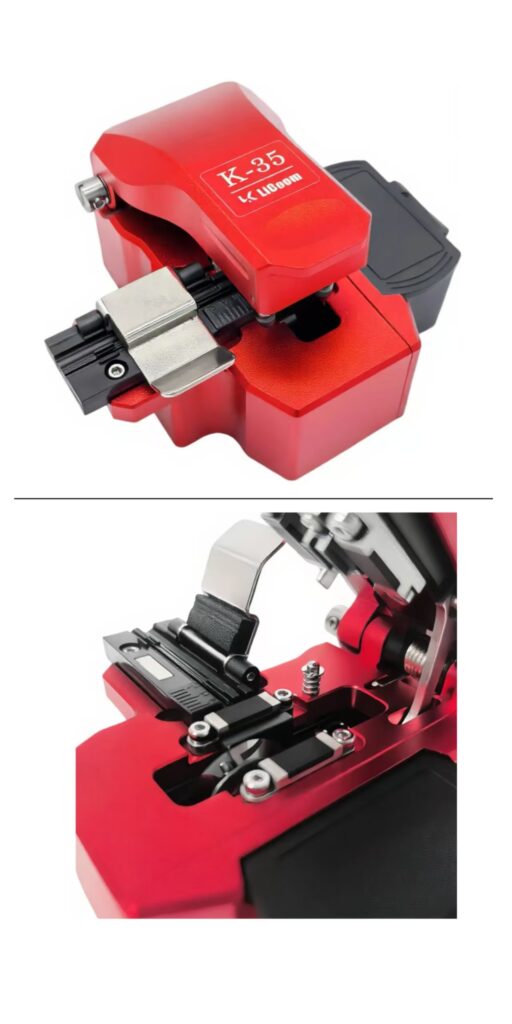
How Long Does a Fiber Cleaver Blade Last? A Comprehensive Guide to Longevity and Precision.
In the world of fiber optic splicing, the cleaver is the unsung hero. A perfect fusion splice starts with a perfect cleave. But as a high-precision tool, the blade is a consumable. Knowing when to rotate, clean, or replace your blade is key to maintaining low decibel (dB) loss and high productivity.
1. The Standard Lifespan: By the Numbers
Typically, a professional-grade fiber cleaver blade (like those used in the LiCoom K-35) is designed with 16 to 24 rotating positions.
Per Position: ~2,000 to 3,000 cleaves.
Total Lifespan: Approximately 48,000 to 54,000 cleaves.
However, these numbers are based on ideal laboratory conditions. In the field, performance can vary.
2. Factors That Shorten Blade Life
Dust and Contamination: Fine debris on the blade acts as an abrasive, dulling the edge faster.
Improper Fiber Stripping: If the coating isn’t fully removed, the blade hits the buffer instead of the glass, causing “chips” on the blade edge.
Harsh Environments: High-temperature and high-humidity areas (common in Middle East infrastructure projects) can lead to micro-oxidation if the tool isn’t stored properly.
3. Signs You Need to Rotate or Replace
Don’t wait for your fusion splicer to show “Cleave Angle Error.” Watch for these red flags:
Increased Splice Loss: Consistently seeing loss above 0.05dB.
Visible Fiber Defects: Shattered ends, lips, or hackles when viewed through the splicer’s camera.
Repeated Re-cleaving: If you have to cleave the same fiber three times to get one good result, your blade is dull.
4. LiCoom’s Expert Maintenance Tips
To get the maximum value out of your LiCoom tools, follow our “Clean-Rotate-Replace” protocol:
Daily Cleaning: Use a lint-free swab with 99% isopropyl alcohol to wipe the blade and the rubber pressure pads.
Strategic Rotation: Only rotate the blade when cleaning no longer fixes the cleave angle issues.
Quality First: Not all blades are created equal. LiCoom uses high-tungsten steel alloys to ensure that the 50,000th cleave is as precise as the first.
Conclusion
A fiber cleaver blade is a small investment that protects a large asset—your network’s integrity. By choosing high-quality tools like the LiCoom K-35 and following a strict maintenance schedule, you can ensure your 50,000-cleave rating is a reality, not just a number on a box.
Looking for high-precision tools for your next FTTH project? Visit Licoom.com to explore our full range of metal-body cleavers and toolkits.