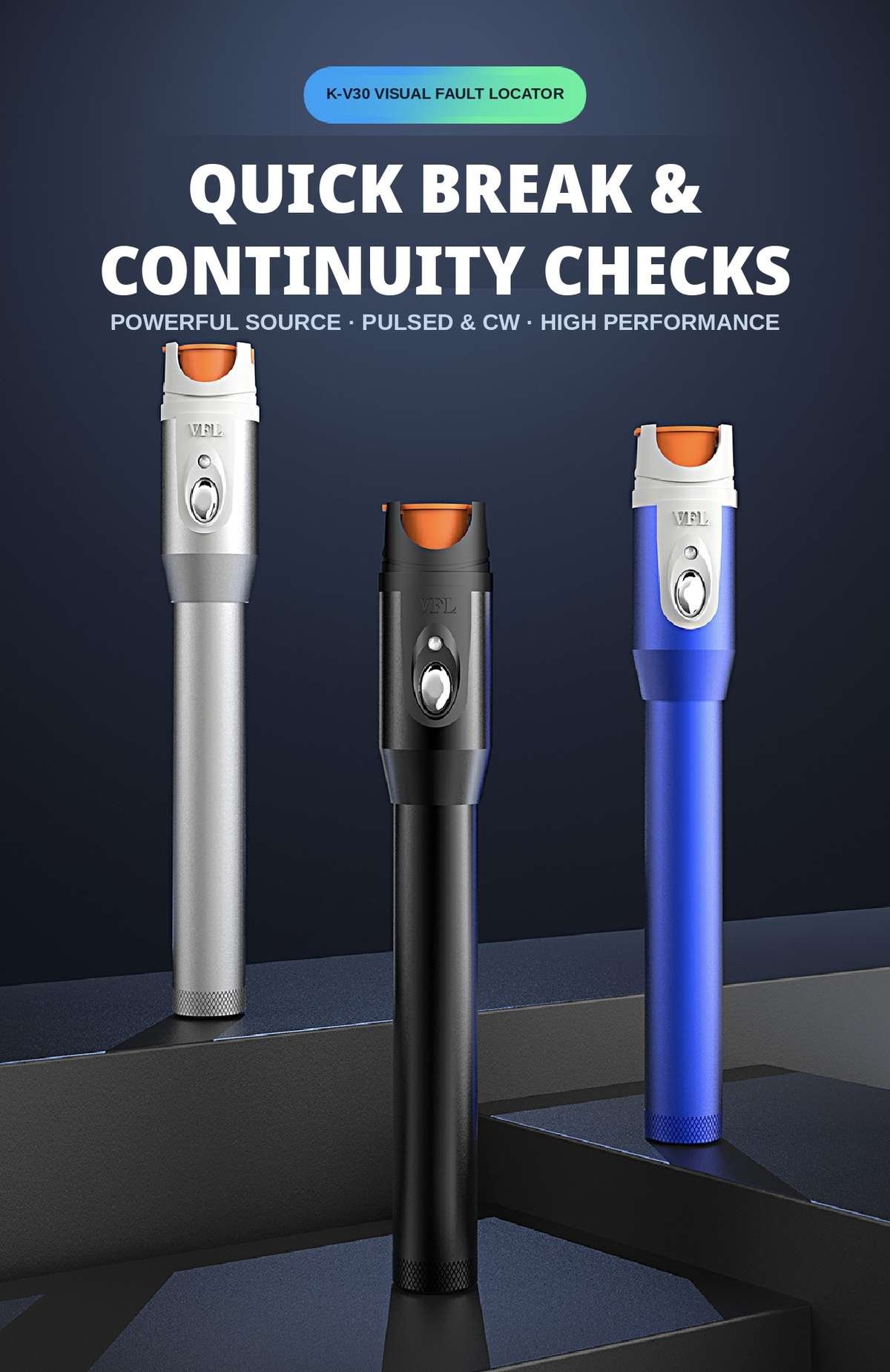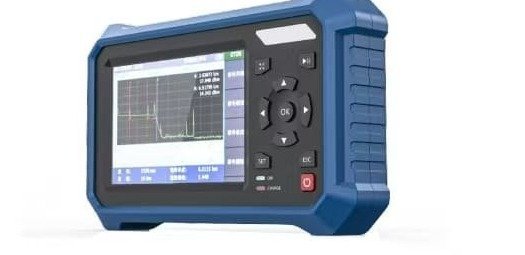
When a fiber link goes dark, the first question is usually the simplest one: where exactly is the break? An optical time-domain reflectometer can answer it from a distance, but it is not always the first tool a technician reaches for. Often the fastest check is a visual fault locator — a pen-sized tool that sends bright red light at 650 nm down the fiber, so the fault itself shows up as a glowing spot, often right through the cable jacket. There is no trace to interpret and no setup to configure.
How the Red Light Test Works
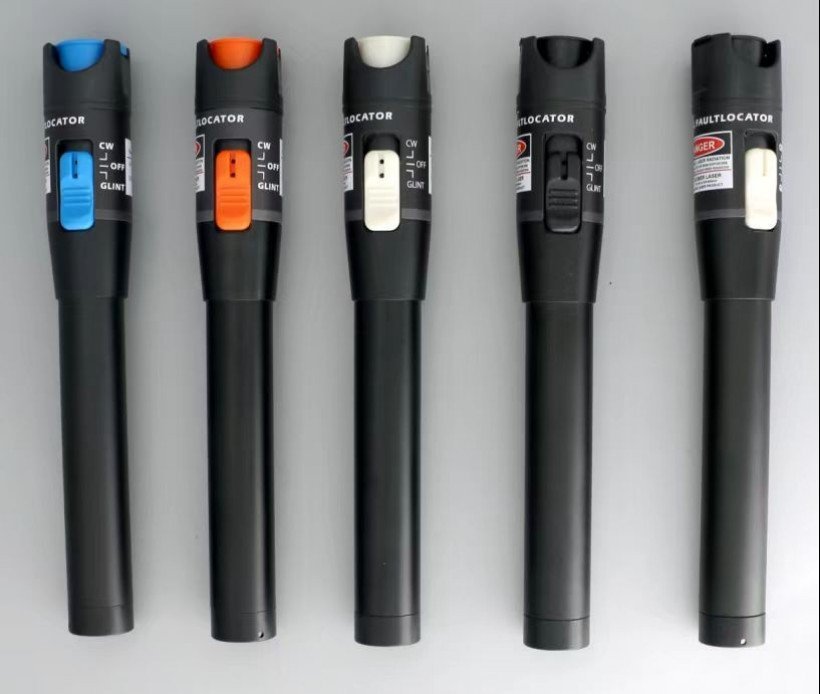
A visual fault locator (VFL) like the K-V10 is a pen-type tool that emits a bright 10 mW red light into the fiber. It connects through a universal 2.5 mm connector, which fits the FC, SC, and ST connectors commonly found on patch cords and field terminations, and it works on both single-mode and multi-mode fiber. That makes it a general-purpose first check rather than a tool tied to one cable type or one connector style.
The K-V10 offers two modes. Continuous wave (CW) gives a steady beam for a quick check: connect, look, and move on. Glint mode pulses the light at 2 Hz, which is easier to spot over a longer run or in a brighter environment, because the flashing point catches the eye.
One more habit matters before the test starts: never look directly into the light coming out of the pen or the far end of the fiber. The beam is bright by design, and the safe way to read the result is to look at the cable jacket and the connector, not into the source.
Running the Check in the Field
In practice, the test follows a short sequence. First, isolate the suspect fiber so you know which strand you are testing. Connect the pen to one end, then work along the run and watch for the glow: at a break, the light spills out and lights up the jacket; at a sharp bend, the same spill appears where the fiber is stressed; at a bad connector, the glow concentrates at the joint. Mark the spot, fix it, and re-test to confirm the glow is gone.
The same technique doubles as a continuity and identification check. Shine the light into one end of a patch cord and the far end should glow — if it does not, the cord itself is suspect. When several unlabelled fibers run together, feeding the light into one strand and watching which far end lights up identifies the fiber end to end. It is also handy close to an OTDR launch, where a reflectometer's own pulse can mask a fault that the red light shows plainly. Where you can, dim the surroundings: in strong daylight, a shaded section of cable makes a faint leak much easier to see.
Where the Red Light Stops
For all its speed, a VFL is a locator, not a measuring instrument — and knowing its limits keeps it from misleading you. The red light fades as it travels, so it suits short runs, patch cords, drop cables, and indoor distribution, not long-haul spans where the light simply runs out before it reaches the fault. It tells you where light escapes, but not how much signal is lost: a link can pass the red-light test and still fail on loss, which is a job for a power meter and, where needed, an OTDR.
Splitters and heavily branched networks are another boundary. Each split divides the light, so the glow weakens quickly past a splitter, and a fault beyond one may not show at all. In those cases the VFL still earns its keep on the individual legs — testing each branch on its own — but it cannot survey the whole tree in one shot. Likewise, a fiber hidden inside an opaque duct will not reveal its glow until the cable is exposed.
Used within those limits, the VFL is one of the best value tools in a field kit: pocket-sized, powered by two AAA batteries, and able to turn a vague "the link is down" into a marked spot on a cable in minutes. Pair it with a power meter for loss checks and an OTDR for long spans, and most everyday faults get found with the cheapest tool first. If your crews still fault-find by swapping patch cords and hoping, a pen-type locator like the K-V10 visual fault locator is a practical place to start — see also The Red Pen That Finds the Break: K-V10 Visual Fault Locator. Tell us what your crews install and we will put together a kit list to match. Contact us through the quote form below or email silvia@licoom.com. EXW factory pricing on request.