Every fiber job starts the same way: before a cleaver, a splicer, or a connector touches the fiber, the coatings have to come off cleanly. And the tool that does that job is not one-size-fits-all. A stripper made for a 3 mm jacket will not prep a bare fiber, and a stripper made for bare fiber will not open an armored cable. Pick the wrong one and the fiber gets nicked; a nicked fiber will not cleave well, and a poor cleave will not splice well. This guide matches five common strippers to the cables they are made for, so the crew reaches for the right tool first time.
Start With the Cable, Not the Tool
Work from the outside of the cable inward. Most fiber cables are built in layers: an outer jacket, then a buffer or armor layer, then the coating around the glass itself. Each layer has its own size, and each stripping hole fits one size. That is why strippers carry several holes, and why the holes are factory-set: the opening has to match the layer exactly, so the coating comes off while the glass underneath stays untouched. Before choosing a tool, identify two things: what cable is in front of you, and which layer you need to remove. The answer to those two questions points straight to the right stripper.
Five Strippers, Five Jobs
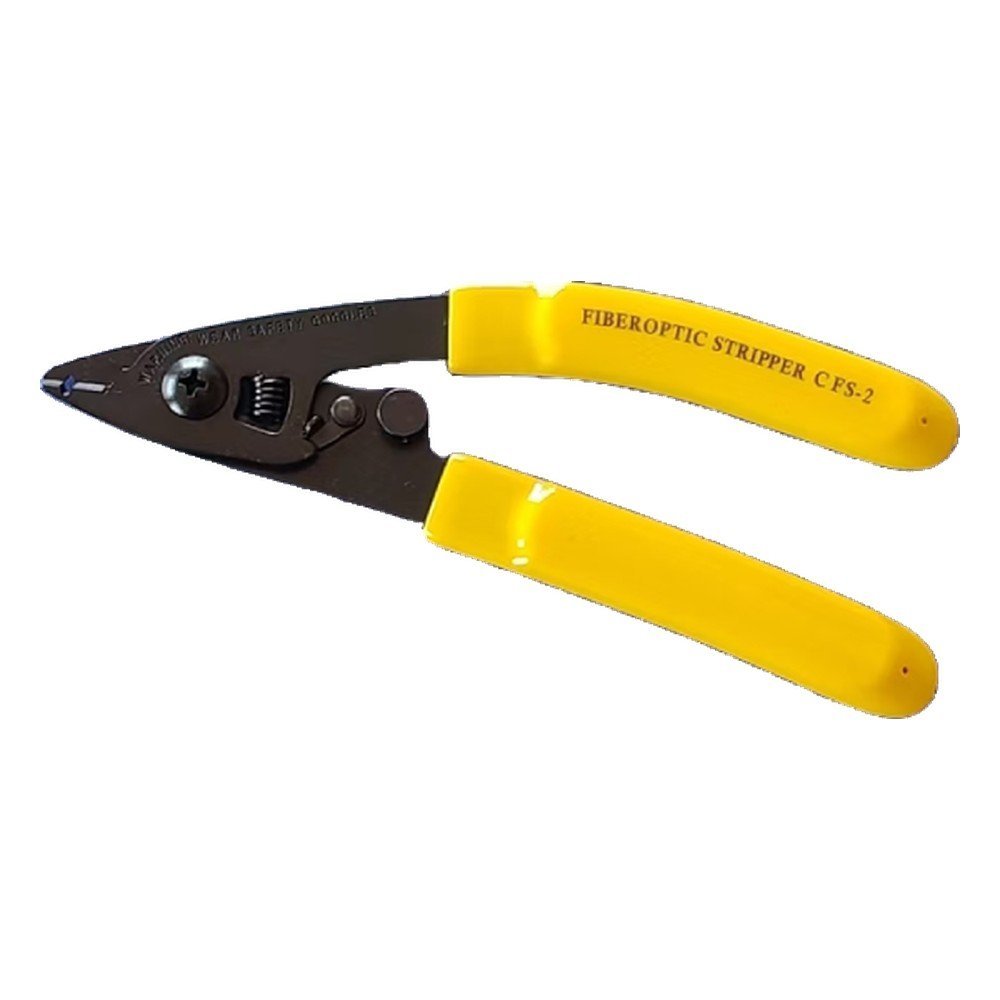
Bare fiber prep: CFS-2/3. When the job is down to the fiber itself, the CFS-2/3 Fiber Optic Stripper is the bench tool. It removes the 250 µm buffer coating to expose the 125 µm glass fiber, and its second hole strips 2–3 mm fiber jackets. It is pre-set at the factory, so there is nothing to adjust, and it locks closed when not in use. This is the stripper for splicing and connector work where a clean, nick-free bare fiber is the whole point.
Mixed termination work: K-870. If the crew preps many kinds of cable at the bench, the K-870 Tri-Hole Fiber Optic Stripper covers three sizes in one hand-held tool: 250 µm, 900 µm, and 3 mm. One tool takes the jacket, the tight buffer, and the coating in sequence, which suits termination, assembly, and repair work where the next cable is never quite the same as the last.
FTTH drop cables: K-6. At the customer premises, the cable is usually a drop cable, and the job is to open its jacket quickly and cleanly. The K-6 FTTH Drop Cable Stripper is made for exactly that: it strips the jacket of FTTH drop cables to expose the fiber for splicing or connectorization at the premises. It is the staple tool for drop installation kits.
Mid-span branching: K-MSAT5. Sometimes the fiber you need is in the middle of a cable that must stay in service. The K-MSAT5 Mid-Span Access Tool opens loose tube cables mid-span and shaves the buffer tube to expose the fibers inside, without breaking or nicking the live fibers you need to reach. It is the standard choice for mid-span branching and repair work on loose tube cables.
Armored cables: K-ACS. Armored cable adds a layer that ordinary strippers cannot handle. The K-ACS Armored Cable Slitter slits the jacket of armored fiber cables so the armor and jacket can be removed without damaging the fibers inside. Two sizes cover the common range: the red model for 4–10 mm cables and the yellow model for 8–28.6 mm cables, for outside-plant, industrial, and campus installations.
A Quick Way to Choose
Put together, the choice is simple. Drop cable at the premises: K-6. Bare fiber prep for a splice or connector: CFS-2/3. A bench that sees mixed jackets, buffers, and coatings all day: K-870. A branch or repair in the middle of a loose tube cable: K-MSAT5. An armored cable: K-ACS, in the size that matches the cable diameter. One more habit helps: check the cable type and diameter before stripping, and use the hole made for that size. A stripper used on the size it was made for leaves the glass smooth; that smooth fiber is what makes the cleave, and the splice after it, turn out right.
To see the full product details for any of these tools, visit their product pages linked above. If you would like to add them to your crew's kit, send us the model numbers and quantities you need through the quote form or write to silvia@licoom.com — we will reply with EXW factory pricing on request, MOQ, and lead time.