Ask three fiber crews what they carry, and you will get three different answers. A drop installation crew spends its day on ladders and in living rooms. A splicing crew works out of a van, joining fibers in closures. A maintenance crew needs to find a fault fast and fix it with what is in the case. Their jobs are different — so why should their tool kits be identical?
That is the problem with a fixed, off-the-shelf kit. It almost always contains one or two tools a crew never touches, and it is almost always missing one tool the crew actually needs. The unused tools add weight and cost. The missing tool means a workaround on site, a trip back to the van, or a job left half done. Neither is a good deal for the crew carrying the case.
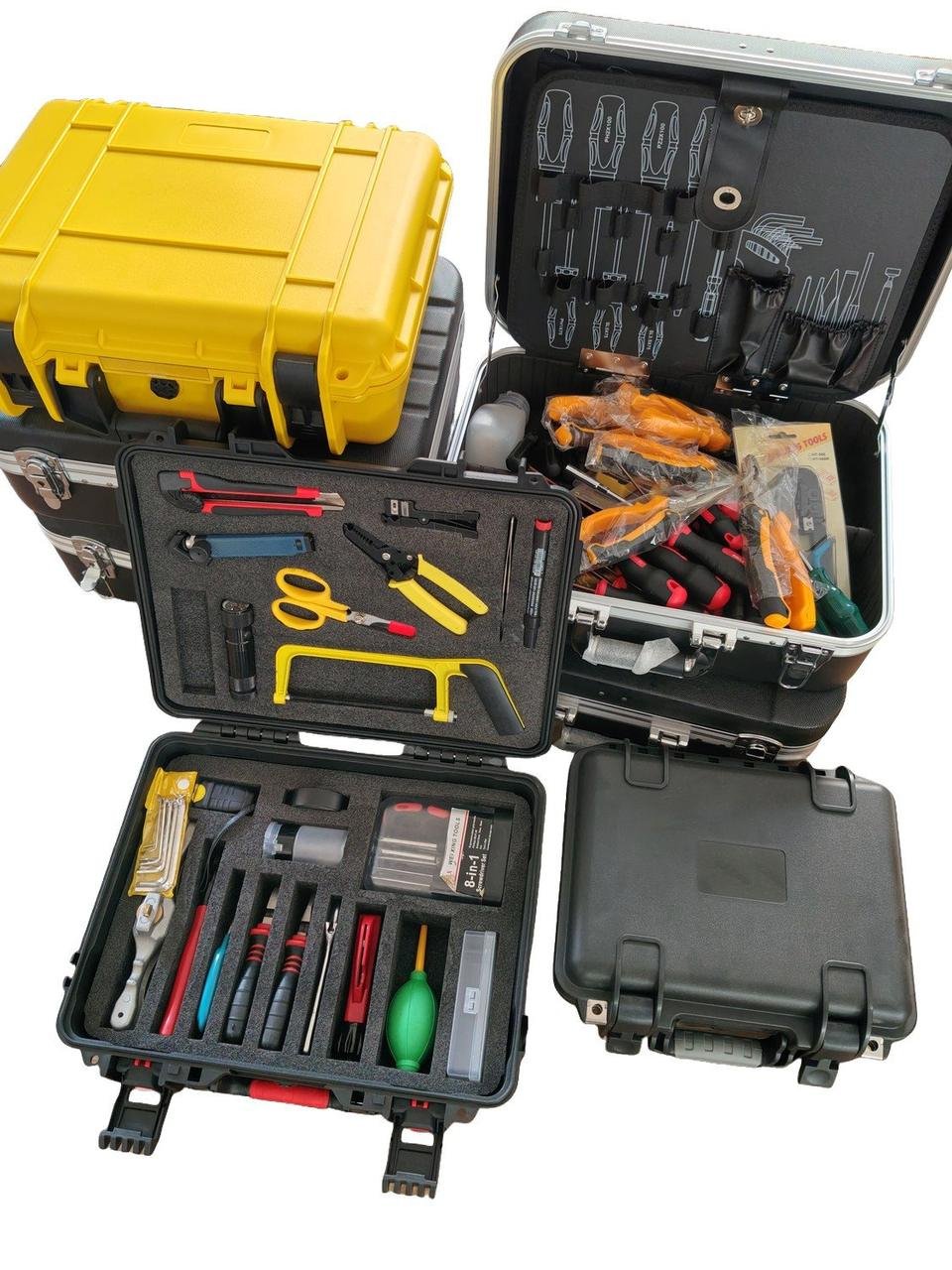
Licoom — Fiber Optic Tools takes the opposite approach: build the kit around the job. Instead of asking a crew to fit a standard set, we start from the work the crew does, pick the tools for that work from our full range, and pack them into the case that suits the job. The photo above shows the idea — hard cases and an aluminum case, each laid out differently, because each one is meant for a different kind of work.
Start From the Work, Not From a List
A kit for drop installation leans on cutting, stripping, and field termination tools. A splicing kit leans on preparation and testing tools that support fusion work. A general maintenance kit needs a broader mix, because the crew never quite knows what the fault will be until it gets there. When the kit is built around the job, every tool in the case earns its place — and nothing rides along just because it happened to be in the standard set.
That also makes the kit easier to live with. A technician who knows every tool in the case — and knows why it is there — works faster and packs up more reliably at the end of the day. There is no guessing, no digging past tools that do not belong, and no surprise when a needed tool turns out to have been left out.
Pick the Case, Then Pick the Label
The case matters as much as the contents. A hard case with foam slots protects tools on rough roads and makes a missing tool obvious at a glance — an empty slot is hard to miss when packing up. An aluminum case suits a different style of work, with its own way of organizing tools and accessories. The case is part of choosing the kit, not an afterthought.
For distributors and brand owners, a custom kit also opens a different kind of conversation. Instead of stocking one standard kit for every customer, a distributor can offer different kits for different customer groups — a straightforward set for installation crews, a fuller set for contractors, a specialist set for a particular kind of work. And because the kit is assembled to order, it can carry the customer's own label. The kit stops being a generic box on a shelf and becomes part of the customer's own offering.
Why Custom Kits Make Business Sense
For the crew, the benefit is simple: the kit fits the job, so the job goes smoother. For the distributor, the benefit is range without clutter. One supplier, one full tool range, and kits assembled to match each customer group — instead of trying to guess which standard kit will sell, or carrying several fixed kits that each please only part of the market.
It also keeps things flexible over time. Jobs change, crews grow, and a new kind of work comes along. A kit built around the job can change with it: swap a tool, change the case, adjust the mix. The kit is not a fixed product that goes out of date — it is a way of putting the right tools together, again and again, for whatever the next job needs.
A good tool kit is not the biggest one, or the one with the most tools in it. It is the one where every tool has a reason to be there. Tell us what your crews do, and we will put together the kit that fits that work — your pick of tools, in the case that suits the job, with your label on it if you want it.
See the fiber optic toolkits of Licoom — Fiber Optic Tools, our OEM & Private Label options, and our K-26 hard case tool kit for one example of a case built to protect its contents. To discuss a kit built around your job, request a quote on the product page or email us at silvia@licoom.com — EXW factory pricing on request.